
What Column Arrays Bring To The Table

Liam Freivald
In recent years, portable column array speaker systems have come onto the market and become popular with many smaller venues and gigging musicians. But why use these new systems in place of often cheaper, traditional “point source” PA speakers? What new advantages do these systems have over traditional PA speakers, and what are the tradeoffs that were made to achieve them?

To start, we should talk about dispersion, or room coverage, as this is the primary advantage of a portable column system. The “angle of dispersion” is essentially the fancy term for the angle from which sound is projected from a given speaker. Most traditional “point source” systems rely on the shaping of the speaker horns the drivers are placed in to push sound at a given dispersion angle, but tend to be fairly linear from the outset, making them great for use in larger venues where they’re often far out from most of the audience and can be placed to cover most of the space, but up-close in smaller spaces can actually be too focused. Column arrays rectify this with their multiple drivers, often given fairly wide coverage even up close (some of them, like Samson’s own ReSound VX8.1, can hit up to 120º dispersion), making them very useful for small-to-medium sized venues. However, in larger spaces, they often can't cover enough space due to not projecting as much sound as far, even in stereo setups.
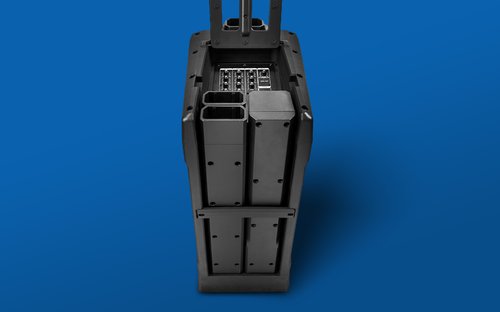
The second obvious advantage is in the name: portability. Traditional PA speakers are typically much more bulky, due to their boxy cabinet designs that have to accommodate fairly large low-end drivers. They also almost always necessitate the use of a stand in order to isolate them from the floor and fully project their sound into the space they’re being used for. Portable column arrays are designed to be easily set up, easily broken down, and easily carried, with designs like Samson’s VX6.1 fitting all of the column segments into the back of the subwoofer enclosure to be carried with one hand. And with subwoofers designed to be set up on the floor itself (like most standalone subwoofers are), the column arrays don’t require setting up a stand, which means another piece of gear that doesn’t need to be carried into a venue, thus the popularity with singer-songwriters and gigging musicians that would prefer to lug around as little gear as possible.
Now, despite their popularity, portable column arrays aren’t simply the best new way to do all live sound ever. Every design decision in a sound system has its tradeoffs, and column arrays are no exception.
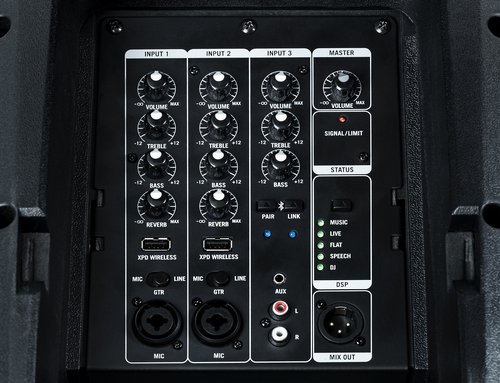
For starters, portable column arrays tend towards more roll-off in the low-end and, in some cases, less articulation in the midrange frequencies. In order to be portable, column arrays tend to lean on 8-inch or 10-inch subwoofers, which when compared to setups with two-way active speakers of equivalent power, aren't capable of pushing as much low-end sub bass frequencies in favor of supplementing the low-mids. The mid-range frequencies can also be a potential issue, as the smaller array drivers favor the high-end frequencies while the subwoofer is still limited to frequencies below 200 Hz (although some column arrays like the VX6.1 can compensate for this to a degree with built-in EQ to tame lows or highs).
There’s also the issue of volume: traditional PA speakers can output louder volumes than column array systems largely because they can simply house more powerful amplifiers and physically move more air with their larger low-end drivers. This feeds into the capability of traditional PA speakers being daisy-chained together to cover larger venues in manners that column arrays can’t quite manage, since managing column array systems in a larger space can cause phasing issues much more of a problem if their wider projection angles happen to overlap in the wrong ways.
However, these tradeoffs still make portable column arrays very viable (and popular) audio solutions for singer-songwriters, mobile DJs and MCs, gigging performers, and small venues. They usually require fast setup, easy portability, and good coverage in relatively small space, as larger spaces are usually set up with their own sound systems, so a column array system is ideal for these cases.
About the Author